
Two Fundamentally Different Ways to Shape Architectural Metal
When specifying a permanent custom address plaque for a masonry residence, historic renovation, or coastal estate, buyers frequently weigh traditional foundry bronze against modern CNC-cut aluminum plate. Although retail catalogs often group both under generic "metal plaques," C83600 sand-cast red brass and CNC waterjet aluminum rely on completely different metallurgical processes, edge geometries, weight classes, and surface coatings.
Selecting the wrong process can leave a coastal beach house fighting galvanic fastener staining, overload hollow EIFS stucco insulation with a 19-pound casting, or place razor-modern sans-serif lettering onto a Tudor brick pier that calls for drafted prismatic relief. Understanding how molten sand casting differs from cold supersonic abrasive cutting makes the right specification obvious.
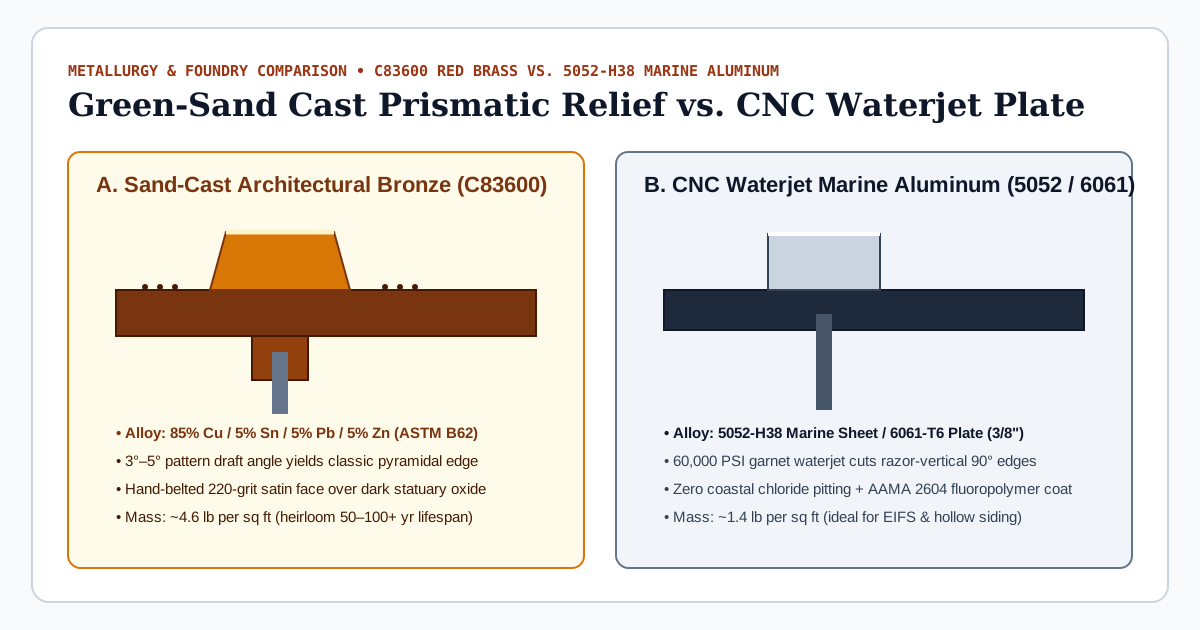
Inside the Foundry: Green-Sand Cast C83600 Architectural Bronze
True architectural bronze plaques are poured from ASTM B62 Alloy C83600—known in North American foundries as "85-5-5-5 ounce metal" (85% copper, 5% tin, 5% lead, and 5% zinc). Unlike yellow hardware brass (C26000/C36000), which has high zinc content susceptible to dezincification in acidic rainwater, tin-stabilized C83600 red brass forms a dense, self-healing cuprous oxide film that endures for 75 to 100+ years outdoors.
Why Sand Casting Creates Drafted Bevels and Textured Backgrounds
To cast a monolithic plaque, a positive CNC-routed or 3D-printed photopolymer pattern of your numerals, street name, and border is rammed into fine olivine or silica sand bonded with bentonite clay. So that the rigid pattern can pull cleanly upward out of the packed sand cavity without tearing the mold walls, every vertical character stroke and border rail is machined with a 3-degree to 5-degree draft angle.
- Prismatic Light Catching: That subtle tapered wall widens the base of each numeral and catches oblique morning and afternoon sunlight along beveled facets, giving cast plaques unmistakable three-dimensional depth.
- Pebble, Leatherette & Sand-Stipple Recesses: Recessed background fields are textured with fine pebble or sand stippling, then flooded with dark statuary bronze oxide or baked polyurethane infill before the raised letter tops are belt-sanded with 180–220 grit belts to expose warm satin bronze.
- Integral Blind Bosses: Threaded mounting bosses are cast directly onto the back of the plate, eliminating weld seams or through-face screw heads when concealed masonry mounting is desired.
Cold Precision: 60,000 PSI CNC Waterjet Marine Aluminum (5052-H38 & 6061-T6)
By contrast, CNC waterjet fabrication starts with wrought solid mill plate—typically 1/4-inch (6.35 mm) or 3/8-inch (9.5 mm) 5052-H38 marine-grade aluminum or 6061-T6 structural aluminum. A 60,000 PSI stream of water mixed with 80-mesh alluvial garnet slices complex scripts, geometric sans-serifs, and custom architectural cutouts without introducing any heat-affected zone (HAZ) or thermal warping.
- Zero Draft Angle (Crisp 90° Walls): Because no mold pattern has to be extracted from sand, waterjet characters exhibit razor-vertical 90-degree sidewalls, crisp internal corners down to 0.040-inch kerf radii, and dead-flat brushed faces.
- Two-Piece Laminated vs. Pocket-Milled Relief: High-contrast custom aluminum signs often mechanically stud-weld or structurally bond brushed satin or brass-anodized 1/4-inch numerals onto a matte obsidian or charcoal AAMA 2604 powder-coated backplate—delivering sharp visual separation with zero paint bleed along stroke edges.
- One-Third the Dead Load: Aluminum has a density of 2.70 g/cm³ compared to 8.83 g/cm³ for cast red brass. An 18 × 10 inch plaque weighs roughly 3.1 lb in 1/4-inch aluminum versus 9.5 to 11.2 lb in cast bronze, making aluminum far safer on cedar lap siding, fiber-cement board, and EIFS insulated stucco.
Head-to-Head Engineering & Climate Comparison
| Specification Metric | Sand-Cast Bronze (C83600) | CNC Waterjet Aluminum (5052 / 6061) | Retail Die-Cast Zinc / Recycled Al |
|---|---|---|---|
| Metallurgical Standard | ASTM B62 (85Cu-5Sn-5Pb-5Zn) | ASTM B209 Marine 5052-H38 / 6061-T6 | Zamak 3 zinc or porous secondary cast Al |
| Edge Wall Profile | 3°–5° pyramidal foundry draft | 90° vertical CNC waterjet wall | Rounded die-cast flash & hollow back |
| Weight (16" × 10" Plaque) | 8.5 – 10.4 lb (solid back) | 2.8 – 3.9 lb | 1.4 – 2.1 lb (thin hollowed web) |
| Coastal Salt Resistance | Excellent (develops natural patina) | Superior (5052 + chromate-free conversion + AAMA 2604) | Poor (white zinc blisters under paint in 18–36 mo) |
| Minimum Stroke Width | 0.125 in (3.2 mm) for clean sand fill | 0.065 in (1.65 mm) fine serif/script detail | 0.160 in+ coarse strokes only |
| Refinishing & Service Life | 50–100+ yrs (re-sandable satin tops) | 20–35+ yrs (super-durable fluoropolymer) | 3–7 yrs before clearcoat peeling |
Clearcoat Maintenance vs. Living Patina in Direct Sun and Coastal Salt
One nuance architects frequently overlook is how clear topcoats age on brushed bronze. Factory-finished bronze plaques receive an oven-baked acrylic polyurethane clearcoat with benzotriazole UV inhibitors to freeze the bright golden-bronze belt finish. On a shaded north porch, that clearcoat lasts 10 to 15 years. On a south-facing Arizona wall or within 1,500 feet of breaking ocean surf, intense UV photons and coastal salt aerosols eventually micro-craze organic clearcoats in 5 to 8 years.
For harsh marine exposures, you have two zero-regret paths: request unlacquered statuary bronze so the plaque ages gracefully and uniformly into an oil-rubbed chocolate-to-verdigris heirloom patina without ever peeling, or specify 5052-H38 CNC waterjet aluminum finished in AAMA 2604/2605 architectural powder coat paired with SAE 316 stainless steel mounting studs so dissimilar-metal galvanic cells never form.
Specifying Border Profiles, Rosettes & Backplate Thickness
Beyond alloy selection, casting thickness and perimeter framing govern structural rigidity over decades of seasonal thermal expansion. Specify a minimum 5/16-inch (7.9 mm) background web thickness on sand-cast bronze plaques wider than 16 inches so molten C83600 fills thin perimeter beads without cold-shut porosity. Choose single-line flat architectural borders for transitional brick homes, stepped double-fillet borders for Georgian and Federal facades, or borderless CNC waterjet plates when mounting flush onto board-formed concrete. Where face screws are required on solid timber gates, request machined bronze or anodized aluminum theft-resistant rosette caps that thread cleanly over stainless collar sleeves.
Ready to preview how cast bronze and brushed marine aluminum pair with your exact house digits and street name? Launch our Live Custom Plaque Composer or send your wall substrate details to our foundry desk via the Custom Quote Desk.
Ready to Preview Your Custom Two-Line Plaque?
Test silhouettes, bronze vs. slate finishes, and kerning proportions in our Live Custom Plaque Composer or email your project specs to info@customaddresssigns.com.