
Natural Quarried Stone vs. Faux Cast-Resin "Stone" Plaques
Genuine quarried stone address plaques bring organic mineral permanence to fieldstone gate pillars, cedar shingle cottages, and mountain timber homes that painted plastic or crushed-limestone polyester resin ("cultured stone") imitations cannot replicate. Under ultraviolet sunlight, resin-bound faux stone chalks and warps within five to seven summers, whereas low-porosity metamorphic slate and igneous granite remain dimensionally unchanged for centuries.
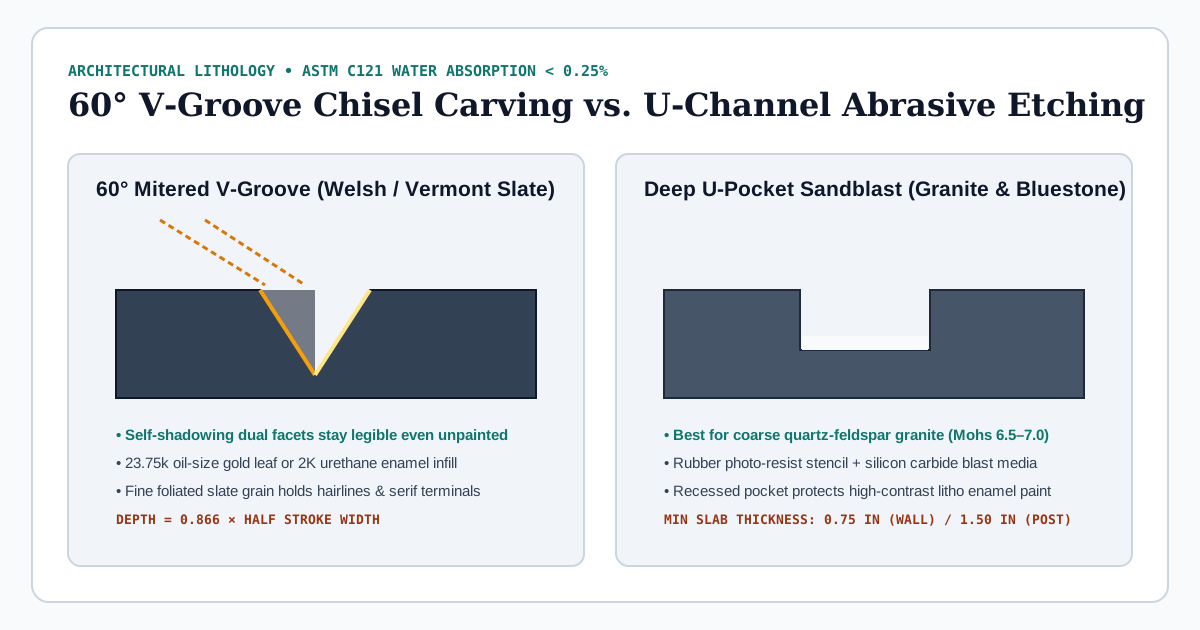
However, not every natural stone belongs outdoors in wet or sub-zero climates, and stone grain size directly dictates whether your lettering should be cut with a 60-degree V-groove carbide/chisel cutter or etched via deep photo-resist abrasive sandblasting.
ASTM C121 Water Absorption & Freeze-Thaw Durability
In northern snowbelts and high-elevation mountain zones, water enters microscopic rock pores during daytime thaws and expands by 9% in volume when night temperatures drop below 32°F (0°C). Stones with high capillary absorption—such as soft Indiana oolitic limestone, porous travertine, or rift-Cleaved craft-store shale—delaminate ("spall") along bedding planes within two or three winters.
- Unfading Welsh & Vermont Architectural Slate (ASTM C406 Grade S1): Metamorphosed under immense tectonic pressure from ultra-fine clay silt, structural Grade S1 slate exhibits an ASTM C121 water absorption rate below 0.15% to 0.25%—virtually impervious to ice wedging and acid rain.
- Fine-Grain Monumental Black & Barre Gray Granite: Crystalline quartz and feldspar interlock at Mohs hardness 6.5–7.0 with water absorption around 0.10% to 0.20%, offering the highest impact resistance for low roadside boulders and lawn monuments exposed to string trimmers or snowplows.
- Thermal-Top Pennsylvania Bluestone: A dense feldspathic sandstone (absorption ~0.9%–1.4%) prized for its warm blue-gray cleft texture; requires sealing the top drip edge and bedding blind studs in non-expanding epoxy for reliable freeze-thaw durability.
60-Degree V-Groove Carving vs. Deep U-Pocket Sandblasting
Why do museum inscriptions and classical English house plaques on honed dark slate look razor-sharp even on overcast days? The secret is the 60-degree V-groove.
How V-Groove Geometry Creates Self-Shadowing Legibility
Using a 60°/90° CNC carbide V-bit or traditional mallet-and-chisel lettering cut, the tool plunges deeper on wider vertical stems and lifts smoothly to a hairline point at serif terminals. Instead of a flat floor, each stroke consists of two angled planar facets meeting at a crisp centerline keel. Whenever daylight or a porch lantern strikes the plaque at an angle, one facet reflects bright specular light while the opposite facet falls into deep crisp shadow.
Slate's microscopic mica-clay grain slices like cold butter without chipping along the top arris. Granite, by contrast, contains 2 to 5 mm crystals of quartz, mica, and feldspar of differing hardness; rotary V-bits chatter across hard quartz grains unless diamond-flooded. Consequently, sandblasted granite uses a thick rubber photo-resist stencil blasted with silicon carbide grit to excavate a clean, vertical-walled U-pocket 0.125 to 0.187 inches deep.
Stone Lithology & Infill Finish Matrix
| Stone Variety | ASTM Water Absorption | Preferred Cutting Method | Highest-Contrast Infill Options |
|---|---|---|---|
| Honed Heather / Charcoal Welsh Slate | 0.12% – 0.22% (Grade S1) | 60° Mitered V-Groove | 23.75k oil-gilded gold leaf, titanium off-white enamel, palladium silver |
| Vermont Unfading Green Slate | 0.18% – 0.25% (Grade S1) | 60° Mitered V-Groove | Cream parchment 2K urethane, 23.75k gold leaf |
| Jet Black Monumental Granite | 0.08% – 0.15% | Deep Photo-Resist Sandblast | Bright white lithochromatic stone enamel, metallic gold |
| Thermal Pennsylvania Bluestone | 0.90% – 1.40% | Deep Sandblast or Wide 90° V-Cut | Matte charcoal-black or warm ivory masonry urethane |
23.75-Karat Gold Leaf vs. Two-Part Litho Enamel Infill
Because dark honed slate has a Light Reflectance Value (LRV) around 10–14, raw unpainted V-grooves look understated at 15 feet on a sunny garden gate but lose contrast after dusk. Filling the carved V-groove with two-part catalyzed aliphatic polyurethane enamel (ivory, crisp white, or satin gold) raises daytime and headlight contrast above 11:1 for 12 to 18 years before touch-up. For true century-grade prestige, 23.75-karat double-weight transfer gold leaf applied over slow-cure oil gold size never oxidizes, tarnishes, or UV-chalks, catching even faint streetlamp illumination across dark Welsh slate.
Minimum Slab Thickness, Drip Chamfers & Concealed Pin Boring
Natural stone plaques must never be cut thinner than 3/4 inch (19 mm) for wall mounting up to 18 inches wide, or 1.25 to 1.50 inches (32–38 mm) for large estate gate markers and freestanding post-mounted slabs. Why? Concealed rear blind-pin holes require at least 0.45 inches of diamond-cored embedment depth while leaving an undisturbed 0.30-inch front stone web behind deep V-carved centerlines so drilling never punches through a carved numeral stroke.
- Perimeter Bevel / Pitched Top Arris: Always specify a
1/8-incheased chamfer or pitched top edge so rainwater and melting sleet shed cleanly forward rather than wicking down behind the slab. - Breathable Siloxane Treatment: If sealing cleft bluestone against oak tannin or lichen staining, use only vapor-permeable penetrating silane/siloxane impregnators—never film-forming topical acrylic wet-look sealers, which trap internal moisture and blister during spring thaws.
- Zero Hammer-Drill Rule: All rear anchor sockets in slate and granite are wet diamond-cored on a rigid drill press to prevent micro-fissures around stainless threaded pins.
Compare Welsh slate against cast bronze and marine aluminum for your exact climate zone in our Climate & Micro-Environment Material Selector or request a carved stone proof via our Architectural Desk.
Ready to Preview Your Custom Two-Line Plaque?
Test silhouettes, bronze vs. slate finishes, and kerning proportions in our Live Custom Plaque Composer or email your project specs to info@customaddresssigns.com.